Wednesday, August 3, 2016

That You Must Do

Morning, Afternoon And Evening Stretches That You Must Do

Everybody should stretch a few times per day in order to keep the body functioning properly, especially those that get minimal exercise. But it can be difficult to keep up with a stretching routine on top of all those other routines we all carry through each day. But the truth is, it’s simply imperative for the wellness of your entire body (inside and out) to get in a few good stretches each day. Preferably, Morning, Noon and Night, just after waking, around lunch time and just before bed.

But what to do? You don’t have time. You don’t have space. You simply don’t know what to do – have no fear – we are here!

As an author, I am granted the liberty to choose how and what kind of content is created for these topics at hand. With that said, I recommend YOGA. Always, no matter what. Whether you’re a gym rat or a couch potato, there are simple (and complicated) yoga poses for everyone. And the really great part is, not only are you stretching, but if you’re doing it right, you’re also relaxing, meditating even, and getting exercise all in the same session.

Where to begin? – in the morning, when you wake up. Drink some water to get the energies flowing. You might try to avoid coffee or tea until after your workout routine, but some experts actually recommend caffeine before a workout. But this isn’t a workout, although it should be treated as such.
I like to begin all my yoga sessions with Child’s Pose. It’s a really great stretch to get your muscles prepared for more stretching, and your mind too.
Kneel down to the mat posing your torso over your hips as you bend forward pushing your arms forward on the mat. Keep your feet touching behind you. Take a few deep breaths (if you’re a beginner, count to five, slowly – longer if you can hold it).
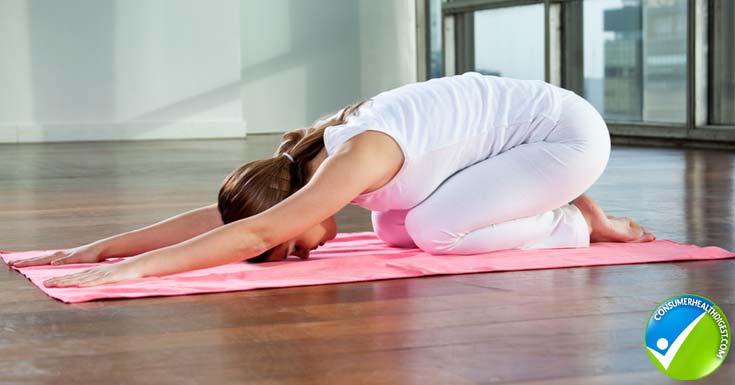
Child Pose
From child’s pose, it’s quite simple to move into cat/cow pose. Simply lift your torso and bring your thighs up off the mat squaring yourself out on all fours.
Slowly breath in and out as you arch your back toward the ceiling and then back down toward the floor. I always try to get at least 10-20 breaths in with this pose. It really stretches the spine and you will feel a difference throughout the rest of the day.
Last quick stretch for the morning – Downward Facing Dog.
From cat/cow pose, easily lift your knees so that you’re balancing your entire body now on all fours, but feet and hands instead of knees and hands. Arch your buttocks up toward the ceiling while pulling your torso in toward your thighs. Hold at least five breaths.
And there’s your morning! – it only took a few minutes. So that was easy… let’s try some afternoon stretches. Afternoons can be especially difficult to get stretches in for those of us that work and travel and lead busy, complicated, public lives. But here’s just another few that you can squeeze in with just a few free minutes in a quiet space:
The Standing Forward Bend is highly recommended by physical therapists far and wide. It’s all about relaxing but you will feel a deep and intense stretch in your hamstrings and upper back.
  • Begin standing straight up and slowly exhale as you bend forward, engaging your abs. Tuck your chin in toward your chest and relax your shoulders. Try to place most of your weight on your toes, while this may be a bit uncomfortable, it’s a super good stretch.
  • You can either let your arms dangle toward the floor or touch your fingers and palms to the far as far as you can reach. Hold for at least five breaths.
Warrior Pose is another strong foundation for your Yoga practice. Similar in nature to the Child’s pose for the meditative factors but also engaging muscles that otherwise might not always be used.
  • Stand straight up on your yoga mat and step your right foot out to the right as far as you can extend. Turn your left heel in, press into your feet and lift your torso up.
  • Lift your arms up, draw your shoulder blades down and toward your hips and gaze up at your hands
  • Hold for at least five breaths and slowly bring yourself back to a standing position before repeating on the other side.
Wide Legged Forward Bend Pose
One more afternoon stretch really gets the shoulders and neck…the Wide Legged Forward Bend Pose
  • From warrior pose you can easily move into this position.
  • Standing straight up on your mat, bring your arms behind you and interlace your fingers into a fist.
  • Inhale and engage your abs pulling your hands away from your shoulders. Exhale as you fold at the hips, keeping the legs and spine straight.
  • Hold for at least five breaths while trying to lower the hands toward the floor. Stand up slowly so as to alleviate a bit of dizziness.
Finally, it’s bed time but you’re still feeling a bit tight, maybe sore from the day’s events. Don’t have time for a bath or a relaxing massage before bed or after dinner?… of course not – so let’s try just a few more stretches to get you rested well and prepared for tomorrow.
Start with butterfly pose which will stretch your hips, hence relieving stresses on the lower body.
  • Sit on the floor with both knees bent and bring your feet together.
  • Pull your feet in as close to your inner thighs as possible, holding them clasped with your hands
  • Bend forward as far as you can, holding the breathing for at least five breaths.
From the butterfly pose you’ll come into the Seated Straddle. This is considered an active pose but it will help you sleep better.
  • From butterfly pose, straighten your legs into a straddle position allowing plenty of space between your heels.
  • Point your knees and toes straight up. Sit straight up with your spine straight and pull your torso in toward your abdomen.
  • Reach out and hold the tips of your toes with your fingers and hold for five to ten breaths.
Lastly, end with Child’s Pose – Rounding out the day
These ‘exercises’ take mere moments from your day and you’ll notice the benefits. Get your Yoga on!

Predicts Alzheimer’s

Smell Test Predicts Alzheimer’s Disease Early, Studies Find

 
According to the Alzheimer’s Association, every 66 seconds someone in the United States develops Alzheimer’s. This severe disease kills more people than breast and prostate cancer combined. It’s estimated that a total of 5.4 million Americans of all ages will have Alzheimer’s disease in 2016. Due to the fact the exact cause of the disease is unknown, detecting cognitive decline and early stages of Alzheimer’s can be difficult. However, findings from two latest studies can change that.

Who Conducted the Studies?

Both studies were conducted by D. P. Devanand and team of scientists at the Columbia University Medical Center as well as the New York State Psychiatric Institute, and Ne-wYork-Presbyterian. Also, findings from both studies were presented at the Alzheimer’s Association’s International Conference in Toronto, Canada. The conference was held from July 22 to July 28, 2016.

Study #1

The first study included 397 adults with the mean age of 80; none of them were diag-nosed with dementia. The participants were administered with USPIT (University of Pennsylvania Smell Identification Test). USPIT is a commercially-available test for smell identification to test the functionality of the person’s olfactory system. It inspects indi-vidual’s ability to detect odors at a suprathreshold level. The test usually takes only a few minutes and includes four 10-page booklets with a total of 40 questions; each page contains different scratch and sniff strip. These tests can also be ordered online.

Also, every participant had an MRI scan that measured the thickness of the first brain area affected by Alzheimer’s disease, the entorhinal cortex. In 2013, the journal Nature Neuroscience published results of the study conducted by researchers at the Columbia University wherein they discovered the exact location in the brain where Alzheimer’s disease starts and from there it spreads to other areas such as the parietal cortex.
This time, researchers discovered that 12.6% of participants i.e. 50 of them developed dementia four years after the study began. Also, 20% of participants experienced cognitive decline. Unlike the entorhinal cortex thickness, the USPIT scores had a strong relationship with Alzheimer’s disease and dementia. On the other hand, the thickness of entorhinal cortex was strongly linked with UPSIT score in individuals who transitioned to dementia.

Low UPSIT scores show reduced ability to identify odors correctly. Moreover, they suc-cessfully predicted cognitive decline. These findings revealed that odor identification impairment has a tremendous potential to predict the transition to dementia. In fact, odor impairment might precede the thickness of the entorhinal cortex in the early stage of the Alzheimer’s disease.

Study #2

This research focused on the usefulness of the UPSIT and tests which measure the amount of amyloid in the brain to predict memory decline. Amyloids are protein pieces that are “sticky” and gradually build up into plaques in individuals with the Alzheimer’s disease.
For the purpose of this study, scientists included 84 participants with the mean age of 71, administered UPSIT and performed either analysis of cerebrospinal fluid or beta amyloid PET scanning. Scans and UPSIT showed that 58 participants had mild cognitive impairment which is why scientists followed them for 6 months and at the follow-up about 67% of participants showed signs of cognitive decline.
Scientists found that testing positive for amyloid successfully predicted cognitive decline, but USPIT score didn’t. Why? Researchers believe it’s due to younger age of participants, shorter follow-up, and higher education.
However, UPSIT is less expensive and easier to administer than PET scanning. Odor identification testing can help doctors counsel patients who are concerned about their memory loss and cognitive decline.

Conclusion

Alzheimer’s disease and dementia affect millions of people in the United States. Both severe diseases are characterized by memory loss and overall cognitive decline. Thanks to two studies presented at theAlzheimer’s Association’s International Conference, healthcare providers will be able to predict cognitive decline successfully with smell test.

THIS IS THE IDEAL BODY OF A WOMAN

SCIENCE SAYS: THIS IS THE IDEAL BODY OF A WOMAN

Each woman is in the search of the ideal body shape. This is because they want to make constant changes, wanting more when it comes to health and look.
pjimage+(11)
Science tried make the things clear to us, trying to find a way to show us how the perfect body should look like.

While we grew up we have come across many different challenges and opinions when it comes to the ideal figure. The fashion industry imposes that skinny bodies are the perfect. But, the truth is that they torture the models in order to fit in their “skinny” creations, living in the world where their dresses fit only thing people.
However, we are against all of this.

We cannot tell the fashion people how to do their job, and instead we will focus on the science. According to a study from the University of Texas the ideal body is the one of a woman who is 1.68m tall ad has 99-63-91 bust/weight/hip measurements.

This is a model named Kelly Brook and she comes from England. People see her like “plump” model, nevertheless, she looks amazing. Scientists say that her body is the ideal regarding fertility and attractiveness. Men are more attracted to the facial and body characteristics like hers and connect them with good health and youth.

Dry skin clean

How to keep your dry skin clean?

It is important to wash your face every day, but more important is not to dry out your skin or get inflamed

  1. Wash your skin once a day. If you have dry skin, washing your face more than once a day is probably skin3 
  2. not a good idea. At night, before going to bed, remove the make up, and wash your skin from the dirt and sweat. In the morning it is acceptable just to refresh the skin on the face with a splash of warm water. Remember to finish with moisturizer.
  3.  
  4. Choose your cleanser carefully. If your skin is dry it gets even dyer if you don’t use the right cleanser. Try using light cleanser for dry skin, make sure that you look for one that does not contain sodium laurel or laureth sulfate. Instead of a store-bought cleanser you can use oil as a cleanser. You should wet your face and apply your oil (almond, olive, jojoba, coconut, etc.). Use a washcloth to rub your face in a circular motion, then rinse away the oil with warm water.


  5. Regularly remove dead skin. If your skin is prone to flaking as a result of extreme dryness you should exfoliate at least once a week. However, you should exfoliate it without drying it out additionally or irritating it. If it is extremely dry the best way to exfoliate it is by using oil. Dip a washcloth or soft towel into oil (of your choice) and rub it into the face using a circular motion. Using a scrub brush is not recommended.
  6. Rinse with lukewarm water. If you rinse your dry skin with hot water, or if you use too much water it will get even dryer. So the best solution is to use only a splash or two of warm water, or simply wipe it with a moist towel.
Use a rich moisturizer Since natural or handmade moisturizers don’t contain chemicals that can cause irritation and dryness, they are best for keeping dry skin looking fresh and hydrated. You should use a moisturizer that contains shea butter, coco butter, or another rich, emollient ingredient that will protect your skin from drying out.

What Happens To Your Body?


If You Eat Garlic and Honey On an Empty Stomach For 7 Days, This Is What Happens To Your Body

If-You-Eat-Garlic-and-Honey-On-an-Empthy-Stomach-For-7-Days-This-Is-What-Happens-To-Your-BodyGarlic is one of the ingredients that are most often used in cuisine around the world. It gives good taste to the food, but also is very powerful and can heal many ailments.
Consuming it raw can be an amazing and powerful medicine.
Garlic can decrease high blood pressure and cholesterol, prevent coronary heart disease and heart attack. Also, it can stop the effects of atherosclerosis.
If you are suffering from everyday health problems like hayfever, traveller’s diarrhea, cold, flu, bug bites and fungal infections, a garlic bulb can help you with it.
Moreover, garlic can help you manage the symptoms of osteoarthritis, diabetes, and an enlarged prostate.
Garlic can improve your immunity and the body’s ability to remove toxins. When it is combined with onion and ginger, it can aid you detox from chemotherapy.
Use of garlic:
The best way to consume garlic is raw, because allicin, its active ingredient is decentralized by heat. Crush and slice the clove and leave it for 15 minutes before consuming it. When you crush the bulp, it activates a reaction that makes alicin more bio available.
It should be eaten on an empty stomach because if the stomach is overwhelmed with food, it has difficulties to process and absorb all the food’s nutrients.

Raw Garlic and Honey

Chop 2-3 garlic cloves into small pieces. Mix them with a tablespoon of honey.
If you take this combination every day, you will feel more energized and healthy.

Garlic Flu Tonic

Wear gloves if you have sensitive skin and don’t rub your eyes when you make this tonic because some of the natural oils can trigger a skin rash or burn.
What you need:
  • Roughly chopped half yellow onion
  • 5 roughly chopped garlic cloves
  • 2 red chili peppers, also roughly chopped
  • 1 tablespoon of chopped ginger
  • Squeezed juice of 1 lemon
  • Raw and unfiltered apple cider vinegar
Preparation?
In a mason jar of 350 ml to 500 ml place the roughly chopped onion. Next, add the chopped garlic. Follow with the red chili peppers, seeds and all.
Then, carefully place some chopped ginger. Squeeze the lemon in a separate bowl, throw away the seeds and then pour the juice.
At the end add the apple cider vinegar and leave about a cm of room at the top. Close the jar and place it on the counter or in a pantry.

How To Skyrocket Turmeric’s Bioavailability?

THIS IS A MUST READ BEFORE EVER USING TURMERIC AGAIN

Turmeric`s active compound called curcumin is responsible for most of its medicinal properties.
01-turmeric-bioavailability-fb
According to the study abstracts from the National Library of Medicine`s bibliographic database known as MEDLINE, turmeric possesses more than 600 health benefits.
However, even though turmeric is extremely beneficial, it is important to read this article and learn some things about its use.

Turmeric’s Key Nutrient Isn’t Easy To Absorb
Although turmeric and its active compounds provide many health benefits, the problem is that curcumin is difficult to absorb.

Many studies have shown that the concentrations of curcumin in peripheral tissues, urine and blood plasma are too low regardless of the turmeric intake, meaning that this low absorption rate doesn’t provide the same health benefits.

How To Skyrocket Turmeric’s Bioavailability?

The good news is that there are various ways to increase turmeric`s bioavailability. Among them are:
  1. Always Mix With Black Pepper
Even when taken alone, black pepper works as potent medicine but it is also shown to work as turmeric adjuvant.
According to NutritionFacts, “If people are given a bunch of turmeric curcumin, within an hour there’s a little bump in the level in their blood stream. We don’t see a large increase because our liver is actively trying to get rid of it. But what if the process is suppressed by taking just a quarter teaspoon’s worth of black pepper? Then you see curcumin levels skyrocket. The same amount of curcumin consumed, but the bioavailability shoots up 2000%. Even just a little pinch of pepper—1/20th of a teaspoon—can significantly boost levels. And guess what a common ingredient in curry powder is besides turmeric? Black pepper.”
  1. Add a Healthy Fat to Turmeric
Given the fact that turmeric is fat-soluble, combining it with a fat is the best way to increase its bioavailability and reap its benefits.
When combined with olive oil, ghee oil, or coconut oil, curcumin is absorbed directly into the bloodstream through the lymphatic system. According to DrNibber, this is of utmost importance because in this way the curcimin stays in its original form and stays in the body much longer.
  1. Heat Increases Turmeric’s Bioavalibility
According to Dr. Sumumar, “The potent ingredient in turmeric is curcumin, which, despite its power, is not easily absorbed by the body without assistance. This is where the sauté pan and a little warm oil come into play.”
“I use it [turmeric] in every sauté, just a quarter teaspoon, a half teaspoon is enough. But you don’t have to use it sparingly – use it lavishly.”
“The better way to take it, I feel, is to use it in your cooking very extensively. If you have any sauté, just sprinkle it in. The moment you heat oil and add turmeric to it, it now becomes completely bioavailable to you.”
Bottom Line
Therefore, to increase turmeric`s bioavailability, you need to do the following things:
  1. Boost turmeric’s absorption by 2,000% by combining it with some freshly ground black pepper.
  2. Mix turmeric with a healthy fat to bypass the liver.
  3. Activate turmeric by heating it up.
According to the University of Maryland Medical Center, the RDA of turmeric is:
  • Cut root: 1.5 – 3 g per day
  • Dried, powdered root: 1 – 3 g per day

Wednesday, January 7, 2015

Coffee is good or bad?


Coffee is good or bad?

Is coffee good or bad for you? Is margarine healthier than butter? What today is regarded as a healthy tomorrow may be declared harmful and vice versa.


 According to the latest scientific knowledge, a number of foods that you eat often is better avoided. And there are those that medics are celebrating as miraculous agents against various diseases. However, these categories are often changing.
 
Do you like cookies with cinnamon?

 
Cinnamon is unhealthy! One of the constituents, coumarin, at high concentrations, can cause liver and kidney damage.

 
Black poison or magic potion?

 
"Coffee causes cancer", "Coffee is bad for the nerves," "A lot of coffee is not good for metabolism" - in short, coffee has long accompanied the belief that it is bad for the health. However, we now know that coffee does not deserve such a reputation. It is believed that even can prevent some types of cancer.

Butter or margarine?

 
Medical experts are pijre many years began to advise that we use margarine instead of butter because it contains far less saturated fat than butter. Others warn that the butter is unhealthy, because it is a product full of unnatural chemicals, "slop" developed in the laboratories of the food industry. And in one and in the other there is truth.

 
Natural enemy?

 
If someone dies of a heart attack, he knows what is on duty suspects - cholesterol. After all, he's the one who blocked blood vessels. Eggs, cheese and red meat pejoratively called "cholesterol bombs."
But the human body is needed holestorol our body produces it himself. Moreover, today most people know that there are "good" and "bad" cholesterol, and is a former "villain" more or less returned a voice.

 
The poison in the soup out of the bag?

 
Glutamate - just do not! The flavor enhancer is considered dangerous not only because the food industry used to "make-up" quality products, but also because, according to some reports, it could cause "Chinese restaurant syndrome".
Apparently it is a disease whose symptoms are sweating, tremors and numbness. However, the existence of such symptoms is not yet proved, no controlled scientific studies.

 
The myth of the freezer?

 
Many people today avoid frozen vegetables. The reason is the assumption that it has less vitamins than fresh vegetables. The truth is quite different - frozen vegetables have far more nutritious and healthy substances, provided they are properly frozen immediately after picking.

 
The fish is salvation?

 
Until recently it was believed that omega-3 fatty acids may protect people from almost all diseases: cancer, heart disease and diseases associated with circulation, even from concentration disorders and depression.
  Medical experts have advised us that every day swallow one capsule with these miraculous elixir. We now know that these saturated fatty acids important for some metabolic functions, but they were not a miraculous means.

 
Exaggeration to health?

 
Vitamins are necessary for our life. First of all we need vitamin C, which defends us from colds and viruses. But studies have failed to prove that the vitamin capsules useful and even appeared and information that they can harm the body. At least now thinks. What will happen tomorrow, the big question is ....

 
The more you drink, it'll be healthier?

 
Thirst is a natural mechanism that informs us about the lack of water. And then someone thought that it might not be enough and that water should be drinking even before you get thirsty. Such experts are recommending us at least three liters of fluid a day.

 
This theory may be rooted in the knowledge that many people in old age they lose the sense of thirst. However, for most people it still works very well.

 
"Natural" means always better?

 
When our food too much chemicals, they are organically grown products a real alternative, because it does not contain pesticides and artificial additives. Or, at least, there is less. But studies show that organic or ecologically grown food does not have to be rich or healthy ingredients the better for our health. The only certainty is that they are expensive.

 
Recipe for Health - moderation

 
Despite the multitude of myths and prejudices, diet and lifestyle play a major role in maintaining good health. Statistics clearly show that smoking, alcohol, weight gain and lack of exercise the greatest enemies of health.

 
Certainly not good every day to eat fried fries from fast food restaurants. At the same time, articles that demonize certain foods while others rise to the heavens should always carefully read. I do not exaggerate - in anything.